THE CONCEPT OF ‘Q’ OF LOUDSPEAKERS
This discussion relates to only low frequence performance of loudspeakers.
Resonance:
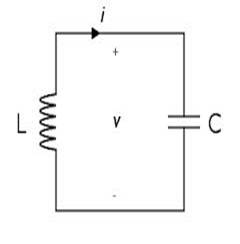
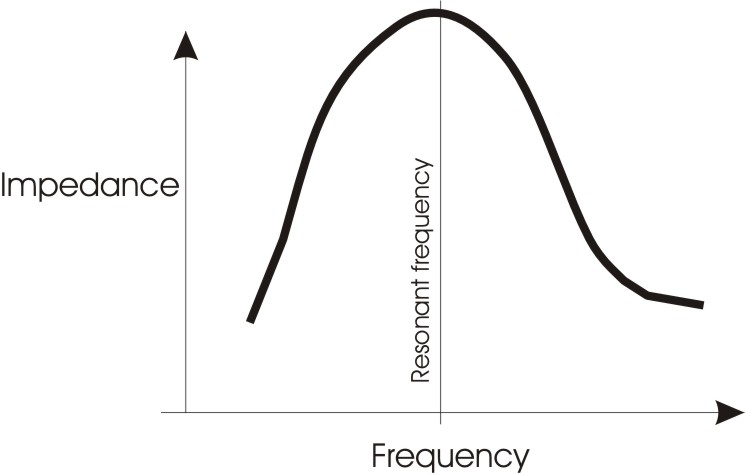
A parallel
electrical resonant circuit consisting of an
inductance and a capacitance shows a peak at the resonant frequency in its
impedance v/s frequency graph. An ideal lossless circuit will show a very sharp
peak; i.e., a high amplitude of peak on a very narrow spread over
frequency band. This sharpness property is called ‘Quality’ or just ‘q’ of the
resonant circuit. The losses in the components cause a reduction in the height
of the peak resulting in a broader peak, consequently having a smaller ‘q’.
These losses are resistive as they are independent of the frequency and are
known as ‘damping’.
In a loudspeaker, there are two elements
that form a similar resonant system:
1. The mass of the moving components –
inertia-equivalent of inductance in an electrical circuit.
2. The restoring spring action of the spider
and suspension-compliance- equivalent to capacitance in electrical circuits.
Compliance is the inverse of stiffness. Stiffer the system is, lesser is the
compliance.
Like the electrical equivalents, both the
above store energy.
A resistance is also present in the
mechanism. This is equivalent to damping in an electrical circuit. This damping
restricts the ‘q’ of the speaker system which is actually useful.
If there is no damping the system will
move excessively at the resonant frequency - a property not
good in a loudspeaker. Hence, we say that the ‘q’ of the loudspeaker (or
speaker system) should not be too high.
It must be remembered that a driver ‘q’ is
controlled by the mass of the moving parts, complance and damping.
Effect
of cabinet:
In practice, a speaker is not used in
isolation. It is enclosed in a cabinet to avoid back and front cancellation of
air compression as the cone moves back and forth. ‘Air’ itself is a
compressible medium and as the cone moves, the air inside the enclosure also
contributes in storing energy. Thus when the speaker is mounted in a cabinet
there is an additional ‘compliance’ of the air in the cabinet. Technically, the
driver and cabinet compliances appear as a series circuit in electrical equivalence.
Thus the total compliance is like the resultant value of capacitors in series:
C= (c1 x c2) / (c1 + c2)
(Note that adding
capacitors in series reduces the final value.)
Hence the lower
value of compliance dominates and the final
value of compliance in a driver-cabinet combination is always lower than the
lower of the compliance between the two.
If the volume of the cabinet is very large,
there will be very small effect on the cone movement but if the volume is small
then the air will get compressed (high stiffness) and affect the speaker
behavior. A large air volume has a large
compliance while small air volume has a small compliance. A Lower
compliance also results in a higher ‘q’. So, when a driver is fitted in a
cabinet, the combined compliance is reduced and overall ‘q’ is increased.
To keep the overall ‘q’ low, we need a
driver of low q or a large compliance of the air in the cabinet. That is
to say, we need a cabinet of large volume (or by filling glasswool in the
cabinet which has a similar effect).
In short, the driver mounted in a ‘sealed’
cabinet will tend to raise the ‘q’ of the overall system and increase the
resonant frequency.
Selecting
q:
Note that ‘q’ is a pure number with no units.
From network principals we know that the value of ‘q’ around 0.7 gives a
maximally flat frequency response. Hence we have to choose the driver and
cabinet combination to achieve the combined ‘q’ of around 0.7. For a given
driver we can achieve the required q only by properly choosing the cobinet
compliance i.e. cabinet volume.
Therefore, if we have a driver of high
compliance then the compliance of the cabinet can be small to effectively keep
low overall compliance and hence lower q. This means a relatively smaller
cabinet. On the other hand if we have a driver with a low compliance
then we need to use a cabinet of higher compliance or a bigger cabinet. In other words,
a soft/loose cone assembly needs a small cabinet while a stiff cone
assembly needs a large cabinet.
If the cabinet is too large, it will have a
very high compliance and dominate the resulting system ‘q’. A very low ‘q’
makes the system inefficient though the frequency response may be smooth to a
lower frequency. It also reduces the power handling capability of the driver.
Conversely, too small a cabinet and a higher q of driver will have a very high
system ‘q’ resulting in a ringing of the driver at resonance, creating a
confused sound quality and loss of distinction of bass notes.
Note that if the ‘q’ of the cabinet with
driver is the same as ‘q’ of the driver alone, i.e. the air volume in the
cabinet has no effect on the final q of the system, then the resultant
resonance frequency of the system will be the same as that of the driver in
free air.
(graphic from
http://www.ht-audio.com/pages/SpeakerBasics.html)
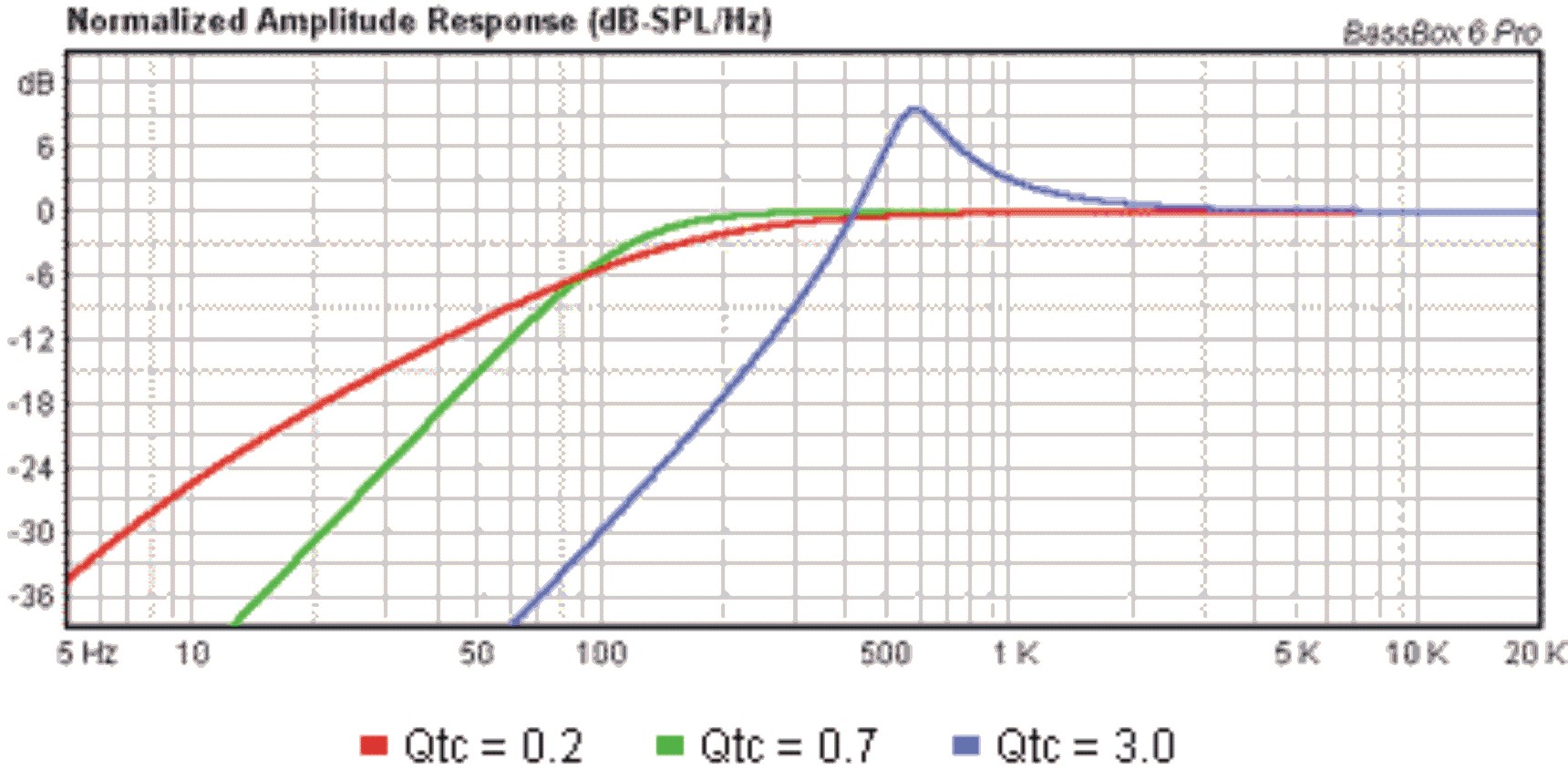
Red curve shows too low Q of the system; Green curve shows optimum Q of
the system; Blue curve shows a too high Q of the system
Note:
1.
Overall
lower output in low frequency region in red curve.
2.
Peaky
response in LF response in blue curve.
3.
Green
curve shows optimum response.
Value of overall q between 0.5 to 0.7
is often used for deep bass reproduction
but it comes with a rduced overall bass loudness. Lower values give a better
transient response.
A higher value of q from 0.7 to about
1.1 is used to produce a warm bass but at the higher value it tends to be
boomy.
Effect of damping:
Higher the damping lower will be the sharpness of resonance peaks and the ‘q’ will be lower. Hence a good damping is required in a speaker system. (glasswool) The damping is not only provided by the speaker system but also by the source impedance of the amplifier that drives the speaker as an electrical damping. Therefore it also important to keep the resistance of cable connecting the speaker to the amplifier as low as possible.
How
electrical damping works: A speaker consist of a
magnet and a coil forming a dynamo like structure. If the cone moves it
produces a voltage at the speaker terminals. If this voltage is short circuited
by a low resistance- like the source resistance of the driving amplifier- the
cone movement is resisted by a back e.m.f. This
dampens the cone movement. This damping controls the movement of the cone at
resonance. Therefore the cone will quickly stop moving as soon as the amplifier
signal stops.
Calculations:
Terminology-
‘Air equivalent’ of the speaker compliance is termed as Vas. This is in
(cubic) volume units.( It can be viewed as an air volume having the same
stifness as the driver suspension); ‘ fs’ is the free air resonant frequency of
the driver. Qts is the driver q.
In practice, to design a sealed cabinet, we take the value of Vas
and Qts from the manufacturer’s data (or better found from tests) and find the volume of the cabinet Vb for the desired
total q of the system (Qtc) as follows:
Formula to be used are-
Vb = Vas / (Qtc²/Qts² - 1)
fc = fs x Qtc/Qts
Note that Qtc is always greater than Qts.
Hence we must choose a driver having a Q smaller than the desired final Q of
the system.
For example, if the driver fs is 45 Hz, Qts
is 0.5; Vas is 50 lit. ; desired Q of the system Qtc is 0.7, then the cabinet
volume Vb is -
Vb= 50/ {(0.7/0.5)2 - 1}
=50/ 1.96 -1
=50/0.96
=52 Lit.
The final resonant frequency fc of the
system will be found as:
Fc= 45 x 0.7/0.5
=63 Hz.
Thus the resultant resonant frequency of the
system will be raised from 45 Hz to 63 Hz
It is worth noting that the smaller the Vas,
smaller will be the resulting cabinet volume for the same final q. Hence it is
good to choose a driver of low q and low Vas.
If we have a diaphragm fitted to a closed
box, and if require the compliance of the enclosed volume of air, it can be
readily calculated as
C= V/ ƍ0 c2Sd2
Where
C is the required compliance, in m/ N
V is the volume of enclosed air in m3
ƍ0 is the density of air
which is 1.2 Kg/m3
c is the velocity of sound in air which is
343 m/sec.
Sd is area of the diaphragm used in m2
While constructing a cabinet the net volume
should be taken as Vb. Actual volume will be bigger considering the volume
takenup by the driver itself and the bracings. If glasswool is included then
the effective volume increases by about 10%. Hence proper allownces must be
made while working out final dimensions. Remember that these are all inside
dimensions of the cabinet.
A sealed cabinet shows a 12 db/octave roll
off in the frequency response below resonance. Therefore the bass reproduction
is smooth.
Different considerations apply while
designing a vented cabinet because the roll- off below the resonant frequency
in a vented cabinet is very rapid (24 db/octave) and cosiderable low frequency
phase shift occurs.
Sarang Lonkar